
 from
from
07/09/2009 at 00:00
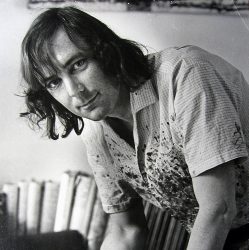
Thank you so much for sending the link to the website honouring Marshall - it's a wonderful tribute.
I vividly remember my first meeting with Marshall - it was 1964, I'd just graduated from Wits (where I'd majored in English and History of Art), was about to go to London for postgraduate study at the Courtauld Institute of Art, and came home one afternoon to find Marshall relaxing by our pool: I was struck by how pale he was, and how skinny - very different from the usual suntanned butch South Africans! We had a long talk about Bach - I'd just bought Jacques Loussier's 'Play Bach', and Marshall disapproved strongly of this jazz interpretation (desecration, I think he called it) of his god. (Bach is one of my gods too, but I enjoyed Loussier's inventiveness.) We also talked about abstraction in art - he was in Johannesburg for his exhibition at Gallery 101. Many of his Jhbg relations were at the opening and I have a crumpled press cutting in front of me, from the Rand Daily Mail of Wednesday 26 February 1964 [my 20th birthday!], with a photo captioned as follows: 'A large crowd attended the opening in Johannesburg on Monday evening by Mr Joel Mervis, Editor of the 'Sunday Times', of an exhibition of paintings by the Rhodesian artist, Marshall Baron. Present at the opening were three of his cousins, Mr Max Loppert and his sister, Miss Susan Loppert (right), and Miss Josie Orkin, who are seen here with Miss Barbara Fink (left).'
We next met at the opening of his exhibition in 1967 or 1968 at the Goodman Gallery, Jhbg. I was visiting from London, where by then I'd landed a job at the Robert Fraser Gallery, 'the' gallery of the Swinging Sixties, featured in Time magazine and Antonioni's Blowup, the gallery where Pop Art was launched, where John Lennon and Yoko Ono floated thousands of white helium balloons into the London twilight during their trail-blazing exhibition, where Bridget Riley showed alongside Eduardo Paolozzi and Jean Dubuffet, Magritte and Lartigue. We talked about the possibility of Marshall's exhibiting in London but it was not to be. It was during that visit that Pauline Jacobson gave a party to which Marshall came with Tamas Vasary after Vasary's splendid recital, and I remember how pleased and happy Marshall was, glowing with his and his friend's successes.
Sadly, since I never returned to live in South Africa, we never met again, but I heard of and about him regularly: I was shocked when my mother, Inkey, who was also a lawyer, told me that during a visit to Bulawayo with her sister Pauline, Marshall had broken down and poured his heart out to her, confiding how unhappy he was, that he felt under enormous pressure to conform and succeed. The tragic death of this lovely, complicated, tortured, talented man was therefore perhaps less of a surprise to me than it might have been.
From time to time I see Yolanda Sonnabend, the eminent set and costume designer, who has very fond memories of Marshall in Bulawayo. She's a year younger than Marshall would have been and bears with fortitude all manner of illnesses and accidents, trials and tribulations; sadly, she doesn't have email but will, I’m sure, be delighted to know about the website.
I vividly remember my first meeting with Marshall - it was 1964, I'd just graduated from Wits (where I'd majored in English and History of Art), was about to go to London for postgraduate study at the Courtauld Institute of Art, and came home one afternoon to find Marshall relaxing by our pool: I was struck by how pale he was, and how skinny - very different from the usual suntanned butch South Africans! We had a long talk about Bach - I'd just bought Jacques Loussier's 'Play Bach', and Marshall disapproved strongly of this jazz interpretation (desecration, I think he called it) of his god. (Bach is one of my gods too, but I enjoyed Loussier's inventiveness.) We also talked about abstraction in art - he was in Johannesburg for his exhibition at Gallery 101. Many of his Jhbg relations were at the opening and I have a crumpled press cutting in front of me, from the Rand Daily Mail of Wednesday 26 February 1964 [my 20th birthday!], with a photo captioned as follows: 'A large crowd attended the opening in Johannesburg on Monday evening by Mr Joel Mervis, Editor of the 'Sunday Times', of an exhibition of paintings by the Rhodesian artist, Marshall Baron. Present at the opening were three of his cousins, Mr Max Loppert and his sister, Miss Susan Loppert (right), and Miss Josie Orkin, who are seen here with Miss Barbara Fink (left).'
We next met at the opening of his exhibition in 1967 or 1968 at the Goodman Gallery, Jhbg. I was visiting from London, where by then I'd landed a job at the Robert Fraser Gallery, 'the' gallery of the Swinging Sixties, featured in Time magazine and Antonioni's Blowup, the gallery where Pop Art was launched, where John Lennon and Yoko Ono floated thousands of white helium balloons into the London twilight during their trail-blazing exhibition, where Bridget Riley showed alongside Eduardo Paolozzi and Jean Dubuffet, Magritte and Lartigue. We talked about the possibility of Marshall's exhibiting in London but it was not to be. It was during that visit that Pauline Jacobson gave a party to which Marshall came with Tamas Vasary after Vasary's splendid recital, and I remember how pleased and happy Marshall was, glowing with his and his friend's successes.
Sadly, since I never returned to live in South Africa, we never met again, but I heard of and about him regularly: I was shocked when my mother, Inkey, who was also a lawyer, told me that during a visit to Bulawayo with her sister Pauline, Marshall had broken down and poured his heart out to her, confiding how unhappy he was, that he felt under enormous pressure to conform and succeed. The tragic death of this lovely, complicated, tortured, talented man was therefore perhaps less of a surprise to me than it might have been.
From time to time I see Yolanda Sonnabend, the eminent set and costume designer, who has very fond memories of Marshall in Bulawayo. She's a year younger than Marshall would have been and bears with fortitude all manner of illnesses and accidents, trials and tribulations; sadly, she doesn't have email but will, I’m sure, be delighted to know about the website.